


The evolution of the fire extinguisher: from glass flasks to the bontel ampoule
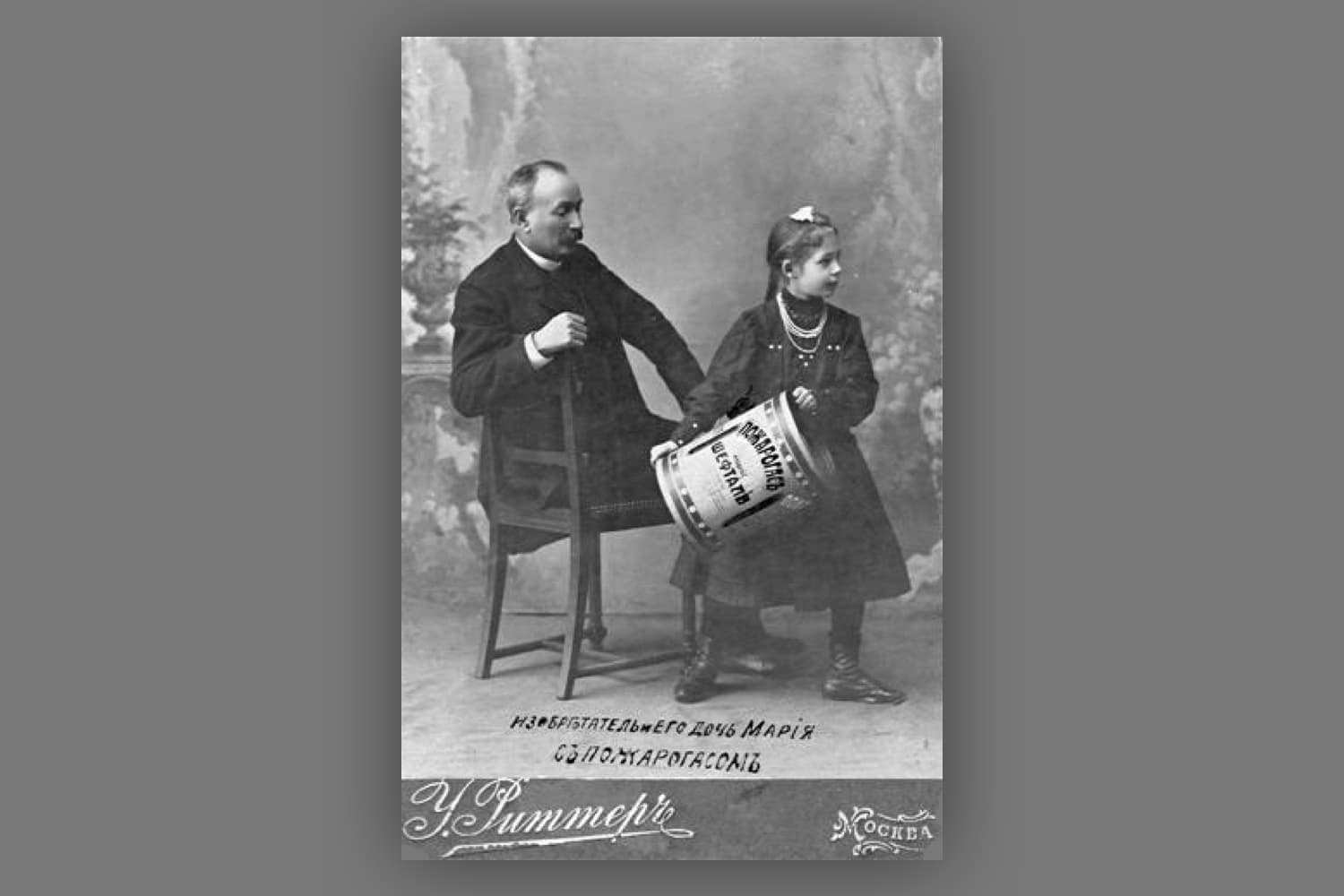
The first foam and CO2 fire extinguishers appeared in the early 20th century. In 1904, Aleksandr Loran, a Russian inventor of French descent, patented a method of extinguishing flammable liquid fires using foam produced by a chemical reaction between alkaline and acidic solutions. To spray the foam, one had to pump it out of the extinguisher with a pump.
For many years, dry chemical and CO2 fire extinguishers were the main weapons against fire. However, they had, and still have, many shortcomings: the former are compact and light, but not very effective, while the latter, in contrast, put out fires well, but are not easy to lift.
With time, fire extinguishers have become more complicated. This includes plugging them into wire harnesses, with water showering from the ceiling in the event of fire. But while this solves one problem, it creates another: it ruins furniture, equipment and documents. In other cases, the detectors are simply not sensitive enough, and the extinguishers do not activate when the fire is in its earliest stages.
In recent years, automatic fire extinguishers have become increasingly popular around the world. BONTEL has pioneered such fire extinguishers in Russia. In tests and in practice, it has been proven that BONTEL fire extinguishers react quickly and cover a wide area. When BONTEL ampoules are installed at a height of 2m, the solution is sprayed to a distance of 2m.
BONTEL products are not affected by wind, rain or sunlight. BONTEL stand-alone fire extinguishing units are so reliable that they will work even when the main fire extinguishing and alarm system does not. The main advantage of BONTEL ampoules is that they nip a fire in the bud, and can do so in any room.
The way they work is simple. A fire near one will set off its automatic safety system. As the temperature rises, the pressure inside the vessel increases. When the temperature of the solution reaches 90°C, the glass breaks, spraying the contents over the seat of the fire.
The extinguishing agent rapidly cools the location of the fire, simultaneously displacing oxygen from the combustion zone. Meanwhile, it forms a thin film on the hot surface, blocking off oxygen and preventing re-ignition.
Dry chemical and CO2 fire extinguishers are not harmless to people: they can even cause chemical burns. BONTEL fire extinguishers are completely harmless to people, as confirmed by all the necessary certificates. The cylinders are filled with an organic liquid, and the portion of the ampoule that breaks in a fire is made of safety glass.
As well as being harmless to humans, the BONTEL liquid is also friendly to equipment and furniture. The film formed on the hot surface turns into carbon dioxide gas and hydrogen on its own after 24 hours –it does not even need to be wiped away. The film does not contain water, and will not cause short circuits – your television or Hi-Fi system will still work even after being sprayed with the BONTEL solution.
These properties make BONTEL products the peak of fire extinguisher evolution. And that evolution has not finished.